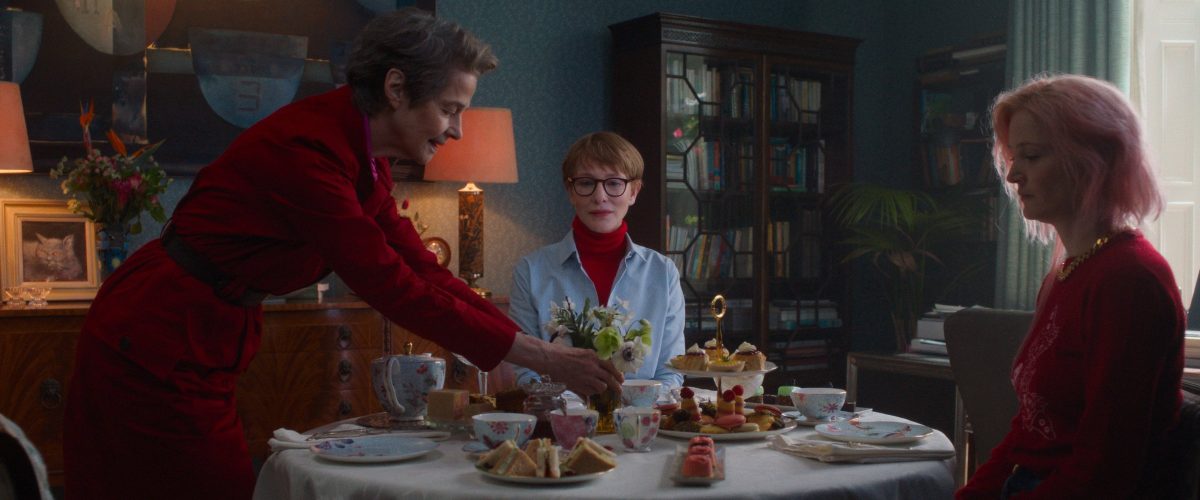
The Golden Lion-winning film FATHER MOTHER SISTER BROTHER directed by Jim Jarmusch is out in cinemas in Italy beginning Thursday, 18 December and in the US on 24 December. The film is also part of International Film Festival Rotterdam (IFFR) lineup, the festival runs from 29 January to 8 February. Cate Blanchett stars with Charlotte Rampling and Vicky Krieps in the section MOTHER set in Dublin.
Exclusive clip from the MOTHER section has been released.
A feature film in the form of a triptych. The three stories all concern the relationships between adult children, their somewhat distant parent (or parents), and each other.
Other release dates:
2025
24 December – Spain
31 December – South Korea
2026
7 January – France
15 January – Portugal
5 February – Hungary
26 February – Germany
27 February – Austria
10 April – Sweden


Google translated from Italian to English
The emotional geography of Father Mother Sister Brother, Jim Jarmusch’s Golden Lion-winning film. In theaters December 18th.
By Margherita BordinoJim Jarmusch’s Father Mother Sister Brother is a film that works by subtraction: three stories, three families, three cities and places that don’t simply host the characters, but breathe them, hold them, explain them. The spaces aren’t a backdrop: they’re an emotional counterpoint, a visual map in which memory and distance become architecture.
Jarmusch, in the opening of each episode, has his characters “glide” on skateboards through seemingly boundless spaces and times. It’s a continuous, almost playful movement, but the slow motion transforms it into a gesture of suspension. That slowed pace, that encounter, that stumble, and, in its own way, that invasion of the scene, serve not to emphasize the action, but to make us feel time passing, as if each trajectory opens a story and freezes it for a moment. Skateboarding thus becomes a way to traverse the world and, at the same time, to stop and observe it.
Each chapter of the film—”Father,” “Mother,” “Sister Brother”—seems to observe the family from a different geographical and emotional angle. First the Northeast of the United States, then Dublin, and finally Paris are not simply places: they are moral climates, atmospheres, and lifestyles that shape the relationships between parents and children, between brothers and sisters. Jim Jarmusch constructs these worlds in a linear and symmetrical way, without obsession, and with the delicacy of someone who knows that environments have a voice, and that that voice must be listened to rather than illustrated.
The set design by Mark Friedberg and Marco Bittner Rosser works precisely on this listening. In the American interiors of “Father,” the material is rich: wood, fabrics, objects accumulated over the years tell of an emotional legacy that’s difficult to navigate. The house seems to hold its breath, as if every surface records an unspoken habit between father and son. In Dublin, in “Mother,” the spaces instead open up to natural light, to a daily routine that flows in silence: dank alleys, small kitchens, living rooms where an object left on the table already speaks of an emotional narrative.
Then comes Paris, the “Sister Brother” chapter, and the set design makes a radical gesture: it empties. The twins’ apartment is almost an echo, a bare place, stripped to the bare essentials. There’s no furniture, no emotional attachments. It’s a space of absence that immediately becomes a symbol: emptiness as legacy, as suspension, as loss. In those almost bare rooms lies everything that’s missing, everything the family can’t hold onto.
The three episodes are interwoven with small, recurring objects, almost ritualistic in their own way—cups, photographs, porcelain, a luxury watch that returns like a ghost of status and distance. These are minimal, almost invisible details, but Jarmusch places them like signs, traces of memory that run through the stories without ever asserting themselves. Their discretion is their strength: they speak of bonds, of what remains and what can no longer be touched.
Full article on Lucky Red

Source: Mubi on X/Twitter (click image)
You can’t choose your family. Jim Jarmusch’s Golden Lion winning triptych FATHER MOTHER SISTER BROTHER. Only in theaters this Christmas.
— MUBI (@mubi) December 10, 2025
Italian Poster

Stills

French Press Kit

Source: IMDb

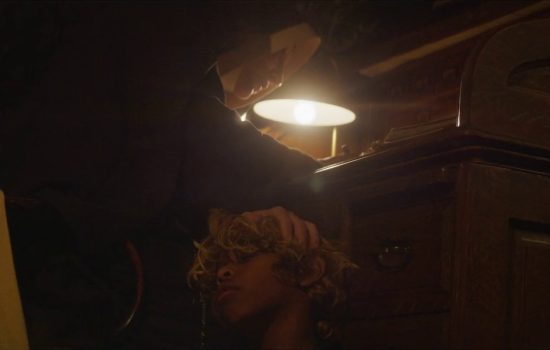
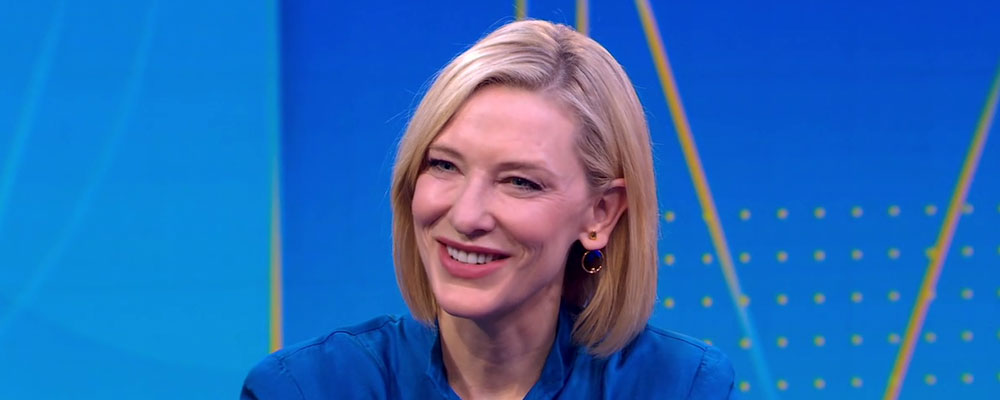


 A Manual for Cleaning Women (202?)
 Electra/Persona (2026)
 Sweetsick (202?)
 Father Mother Brother Sister (2025)
  Black Bag (2025)
  The Seagull (2025)
 Bozo Over Roses (2025)
 Disclaimer (2024)
  Rumours (2024)
  Borderlands (2024)
  The New Boy (2023)


