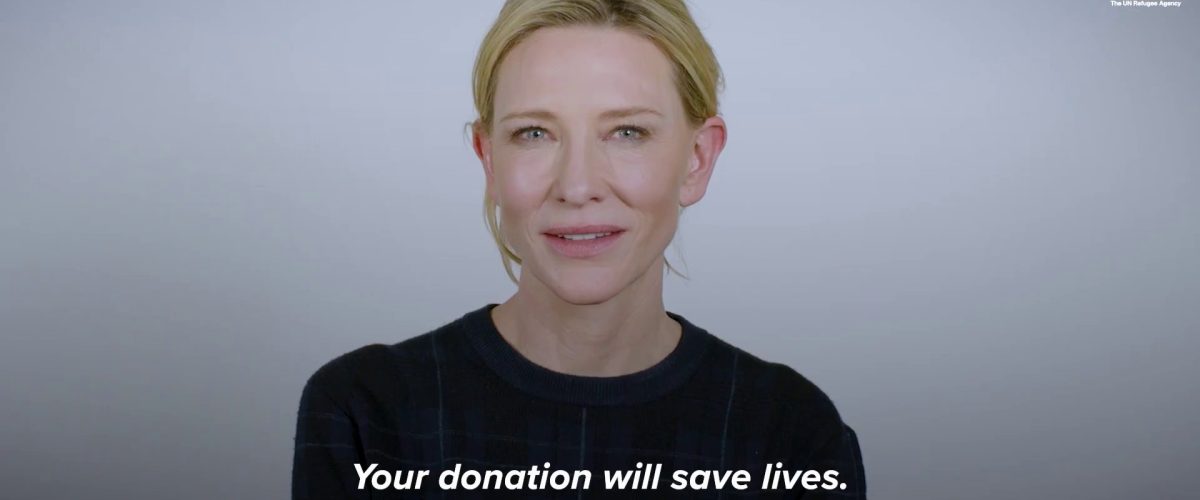
UNHCR Goodwill Ambassador Cate Blanchett urges people to donate to UNHCR to help refugees and people who are displaced especially this winter.
You can follow UNHCR on their social media platforms (Twitter, Facebook, Instagram, YouTube, BlueSky) for updates and you can also help spread awareness of the plight of refugees by sharing their posts. If you would like to donate, you can follow the link here.


Oscar winning legend Cate Blanchett, who has returned to Jarmusch for the first time in 22 years—since her segment of Jarmusch’s 2003 omnibus Coffee & Cigarettes—sees his films as treatises on the holistic human experience. “He loves the absurdity of being alive,” Blanchett says, “and he’s always trying to figure out, how the hell do we all find ourselves in the same room together? How are we going to work this thing out? And he does it with great love and great humor. You remember his films because they’re not merely amusing, they’re not merely beautiful, they’re not merely stunningly visual. There is a melancholy and kind of a longing and a love in them. There’s a heartbeat in them that I think is very particular to him.”
“I don’t know a single person who doesn’t love and is in love with Jim. [His] persona can somehow seem remote in a way. It’s so alluring yet he is so warm and caring and frank and funny. And I think all of those qualities are in his films.” Blanchett says. Jarmusch builds his characters around his collaborators and writes to them. It’s an extension of the grand design of a Jarmusch film, an attempt to capture life how it is by using actors you know and have worked with and using that pre-formed knowledge to relate the essence of, say, Roberto Benigni or John Lurie or Alfred Molina. He also casts actors that have pre-formed relationships with each other, to mine that history, as Jarmusch did with Isaach De Bankolé in Limits of Control with two of his frequent co-stars, Paz de la Huerta and Alex Descas. “Everyone with all their different quirks and perspectives, he brings them into the same room and gets them to play jazz together,” Blanchett says. “And he does that with the audience in the same way that he does that with his actors and his crew.”
One of the kernels of Father Mother Sister Brother was Jarmusch’s observation that it would be funny to have Adam Driver play Tom Waits’ son. He will use his players against their typecasting. “It’s a cliche to say that the casting is an important part of the process, but it’s absolutely central for Jim. And he then writes to the people that he’s cast, so once you’ve got on set, you’re all on the same page. He’s really engaged with what people will bring. So people feel really valued and they just are really relaxed, they don’t feel like they have to do anything other than do what they’re feeling in the moment.” Blanchett says.
FMSB also represents an evolution of Jarmusch’s conversational approach to filmmaking. It’s quite possibly the most cohesive, precisely shot and written effort of his career; each vignette leans on the last and builds to a poignant, emotional conclusion. “This one was very delicately constructed to accumulate. If you showed them out of order, or separately, I would be mortified.” Jim says. Blanchett contrasted the experience with her role in Coffee & Cigarettes. “Perhaps more so than the previous time that I’ve worked with him, there was a kind of an architecture which really needed to be maintained so that all the discrete parts of the film would work as the jigsaw that they needed to fit together as.”
And yet Jarmusch brought his standard openness to the making of the film. He had intended for Blanchett, whose Dublin-set vignette features two sisters and their mother, to play Lillith, the closeted gay punk younger sister. Instead, Blanchett said the role of the prim older sister Timothea spoke to her, so she was given that part, and Vicky Krieps stepped into the role intended for Blanchett.
Full article on GQ
Google translated from Greek to English
There are people who carry their legend like a heavy velvet coat. There are also those – a few – who leave it on the hanger before entering the room. Cate Blanchett belongs to the second category. One of the rare cases where simplicity is not a pose, but a core dimension of talent.
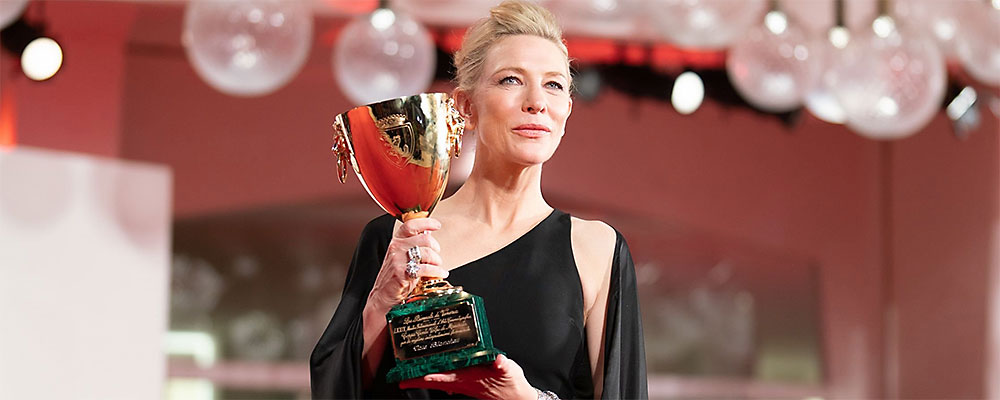
Our date was initially on a video call that, after five minutes, she decided not to, as if her brilliance had given her an electric shock. So, we recorded it on the phone, without cameras, without screens, only with the warmth of her voice. That voice that seems to sculpt words instead of pronouncing them. We spoke on the occasion of her participation in Father Mother Sister Brother, Jim Jarmusch’s new film that won the Golden Lion at the recent Venice Film Festival and will be released exclusively in Greek theaters this Christmas. The minimalist director weaves three different stories that explore the relationships of adult children with emotionally distant parents and the invisible aspects of family dynamics. In the film’s second story (Mother), the annual tea date of an arrogant mother (Charlotte Rampling) with her two daughters – the introverted Timothea (Cate Blanchett) and the explosive Lilith (Vicky Krieps) – becomes a mirror of the delicate balances in the mother-daughter relationship, but also of the fragile dynamic between two women who, although sisters, seem to inhabit different worlds.
“I wanted to play a woman whose life is nothing spectacular,” Blanchett tells me on the other end of the line. “There was a discussion about what role I would play, and I felt like Timothea was a personality that had escaped me, in a way. I was interested in exploring a person who goes a little unnoticed. You know, in every family there’s that one person who makes noise and, ultimately, gets all the attention. But I wanted to play a character who was very reserved, clean, pure, honest, transparent, trustworthy. Characteristics that, usually, don’t easily catch the eye in a family dynamic, On the other hand, I’m obsessed with the relationships between sisters and mothers, because I’m very close to my own sister. So, it wasn’t just the character. It was the whole dynamic between the three women that really appealed to me.”
I wonder if the film stirred up memories of her own family. Blanchett was born in 1969 in a suburb of Melbourne. Her Australian mother was a teacher and property developer, while her American father served as a petty officer in the US Navy before working as an advertiser. She has an older brother and a younger sister, and when she was ten, her father died of a heart attack, leaving her mother to raise their family alone. Since 1997, she has also started a family of her own. She is married to playwright and screenwriter Andrew Upton, and together they have three sons and a daughter. “Our family, our exposure to a certain way of life, shapes the ‘language’ with which we interpret things, a way of adapting to the space and circumstances. My heroine’s awkwardness, in my opinion, is born of expectations of how she should behave. Self-expression, when it becomes an obligation, is overrated. You can absorb influences without having to constantly produce “outward” emotion or speech. Sometimes you just have to be quiet. That’s where my character is in the film. And, yes, I feel that too. There’s always the expectation that an actor has to express themselves nonstop. But I’m not sure that’s the natural human condition.”
I ask her if she’s ever been in a family gathering, like the one in the film, and felt that the dynamics in the members’ relationships were being tested. “My own family was very silent,” she replies. “Very reserved. Now I’m going to do a simple psychoanalysis, but I often think that maybe that’s why I do this job, that I long so much to be in theater rehearsals and film sets, because there’s a lot of noise, a lot of pulse. And yet, my natural “setting” is not particularly social. I like sociability, but it tires me out, it exhausts me a little.”
While talking to her, I understand why great filmmakers trust her blindly. Because she never forces the moment. On the contrary, she lets it breathe. Meeting Jarmusch on this film, years after Coffee and Cigarettes, was like a gift to her. “He’s so idiosyncratic!” she says. “You’d think he’d be incredibly ‘fluid,’ but he’s actually extremely specific. Like jazz: he improvises, but at the same time he has his own frame of reference. And one more thing: he really loves the people he works with, he wants to see how they’ll ‘play’ on his material. He’s incredibly kind and mischievous, which I love. For me, what mattered was getting back together with Jim after a long time. I had moved back to Australia, I have four children, and I didn’t travel that often anymore. We kind of got off track, even though we had met before. So when he said to me, “I’m making a movie. Do you want to do it?”, I said yes without even reading the script. But I was really happy to meet Charlotte Rampling and Vicky Krieps. We spent three weeks together in Ireland, in the same house. They had given us separate rooms, but we all ended up cramming into the bed in Charlotte’s room. It was something between a lazy afternoon and a kids’ sleepover. Simply divine. I have such fond memories of filming. It was heaven!”
Not long ago, the two-time Oscar-winning actress found herself in Messinia, wandering the alleys of Kardamyli and West Mani for the filming of her new film, Sweetsick, directed by Alice Birch. “It was incredible! I had never been there before,” she tells me like a little kid being taken to an amusement park. “I’ve traveled to the Cyclades, I’ve visited Athens, but this place was something else. Fantastic! The crew was mostly locals, so there was a real sense of adventure. They took us to some remote sea caves and we went diving, it was great. But, you know what, we came to Greece for the sun and the heat and because at the end of the summer there wouldn’t be any tourists anymore, and we ended up getting hit by lightning, thunder, torrential rain and flooding. The weather was absolutely crazy. But, I guess, that’s the climate crisis.”
She bids me farewell with a “Take care!” that sounds like a motherly caress, as bright as her voice, which for half an hour flowed in my ears like warm water, leaving her most personal thought for the end of our conversation: “I hope people never lose the dream. Cinema is a collective dream. I love being in dark rooms with strangers, whether it’s a small screening room or a huge cinema, or even when I’m in the theater. I love these spaces, because I find great comfort in being a spectator with other people, but also in creating works for other people, knowing that they will consume them, digest them and digest them again in the darkness. I love it!”.
Vogue Greece




 A Manual for Cleaning Women (202?)
 Electra/Persona (2026)
 Sweetsick (202?)
 Father Mother Brother Sister (2025)
  Black Bag (2025)
  The Seagull (2025)
 Bozo Over Roses (2025)
 Disclaimer (2024)
  Rumours (2024)
  Borderlands (2024)
  The New Boy (2023)


